
The Carbon Economy Has Already Begun
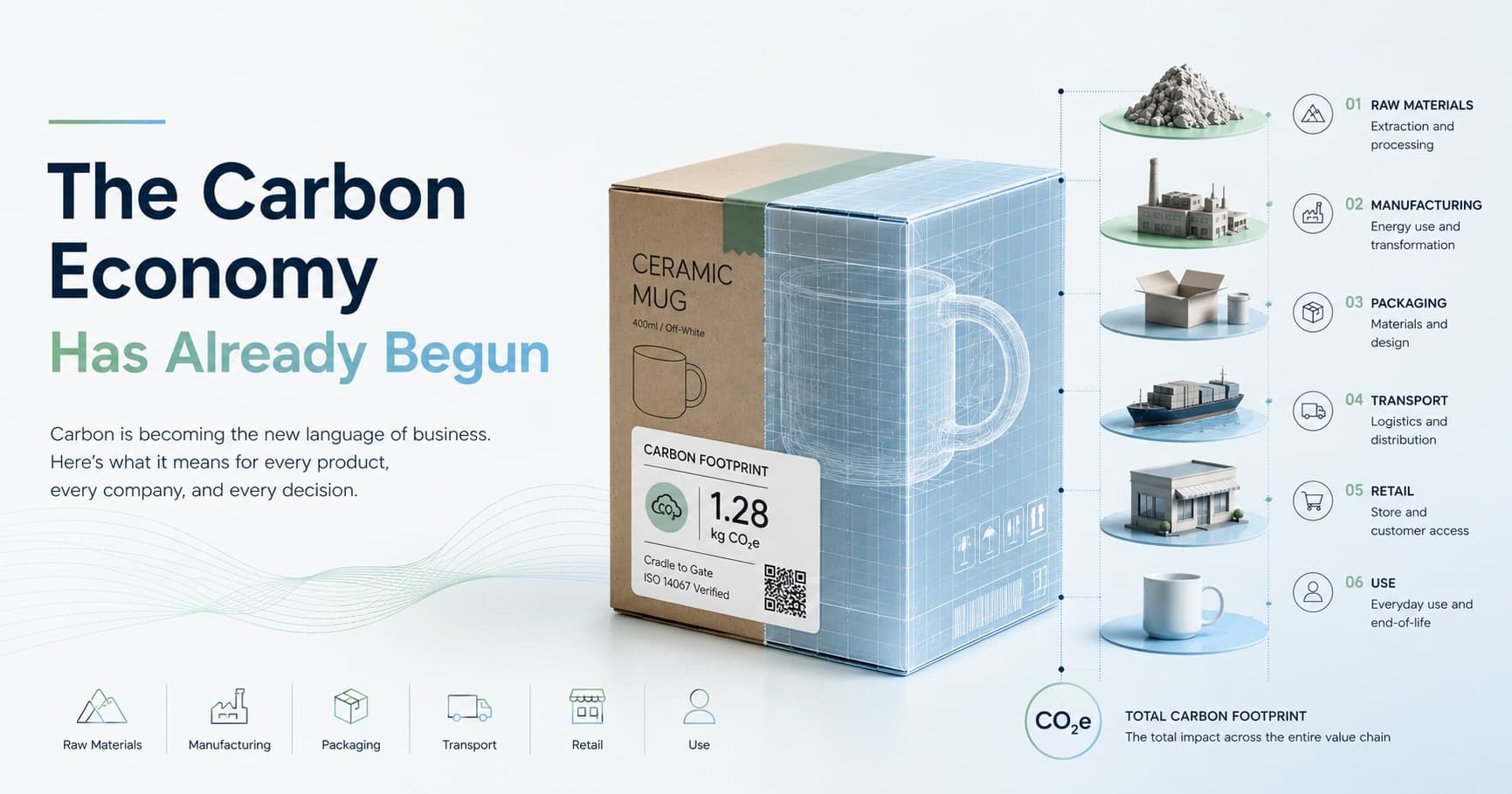
Many people still see carbon footprint as an environmental issue. Something for the sustainability team. A regulatory requirement. A report to be completed for each batch.
But a quiet shift is underway.
Carbon is becoming more than an environmental metric. It is becoming a new language of business.
On 1 January 2026, the European Union entered the full implementation phase of the Carbon Border Adjustment Mechanism (CBAM), requiring importers of certain products to account for the greenhouse gas emissions embedded in those goods. It is one of the clearest signals yet that carbon is no longer simply an environmental concern. It is becoming part of the infrastructure of international trade.
The implications extend well beyond companies exporting directly to Europe. As large organisations measure and report emissions across their value chains, suppliers are increasingly being asked to provide reliable carbon data to support procurement, risk management, sustainability reporting, and customer expectations.
Business is beginning to ask a new question. Not only,
“How much does this product cost?”
but also,
“What impact did it create before it reached the customer?”
Every Economy Has Its Own Language
Every era of economic development has been defined by the information businesses considered valuable.
The Industrial Age rewarded production capacity.
As markets matured, quality, efficiency, and standardisation became competitive advantages.
The digital economy transformed data into one of the world’s most valuable assets. Businesses that understood customers, markets, and operations through data consistently outperformed those that relied on intuition alone.
Today, another transition is quietly taking place. Carbon data is beginning to occupy a similar role.
It may not yet be essential for every business, but its importance is steadily growing across manufacturing, procurement, exports, investment, and supply chain management.
Every economy develops its own common language. Carbon may well become one of the defining languages of the next.
Carbon Footprint Is Not Just a Number
Carbon footprint is often viewed as a reporting requirement.
In reality, it is a way of understanding a product more deeply. Every product tells a story.
- Where its materials came from.
- How it was manufactured.
- How much energy it consumed.
- How far it travelled.
Each step leaves behind information that was previously invisible.
When companies begin measuring carbon, many discover opportunities they had never recognised before.
- Unnecessary transportation.
- Energy-intensive production processes.
- Packaging that can be redesigned.
- Suppliers with significantly different environmental impacts.
The real value of carbon measurement is not the number itself. It is the visibility it creates.
Because what can be measured can be understood. And what can be understood can be improved.
From Compliance to Competitive Advantage
Many organisations still approach carbon footprint as an additional cost.
- Another requirement.
- Another audit.
- Another report.
But viewed differently, carbon data becomes an investment in better decision-making.
Understanding where emissions occur often reveals where resources are being consumed inefficiently.
Knowing which suppliers perform better leads to more informed procurement decisions.
Sharing transparent, verifiable data strengthens credibility with customers, investors, and business partners.
Trust is no longer built only through brand promises. Increasingly, it is built through information.
Carbon footprint is therefore not simply about reducing emissions. It is about understanding a business with greater clarity. And businesses that understand themselves more deeply are almost always better positioned to adapt, innovate, and compete.
The Carbon Economy Is Ultimately About Transparency
Perhaps the greatest shift is not carbon itself. It is transparency.
- Customers increasingly want to know how products are made.
- Investors seek greater visibility into business risks.
- Supply chain partners expect reliable information that allows everyone to move forward together.
Carbon data is simply one expression of this broader transformation. The future economy will reward businesses that are not only efficient, but also measurable, understandable, and transparent.
The value of a product will no longer be defined solely by what we can see. It will increasingly include the information that stands behind it.
The Beginning of a New Era
There was a time when having a website was optional. Later, it became a basic expectation.
Digital data followed the same path, evolving from novelty to essential business infrastructure.
Carbon data may be following a similar trajectory. Not because regulations demand it. Not because markets insist upon it. But because businesses that understand themselves through better information consistently make better decisions.
Perhaps the question is no longer whether carbon footprint matters. The more meaningful question is this:
When carbon becomes part of the language of business, will your organisation be ready to speak it?
Because the carbon economy is not something waiting in the future. It has already begun.
References
- European Commission. Carbon Border Adjustment Mechanism (CBAM). https://taxation-customs.ec.europa.eu/carbon-border-adjustment-mechanism_en
- European Commission. CBAM Legislation and Guidance. https://taxation-customs.ec.europa.eu/carbon-border-adjustment-mechanism/cbam-legislation-and-guidance_en
- European Commission. Corporate Sustainability Reporting Directive (CSRD). https://finance.ec.europa.eu/capital-markets-union-and-financial-markets/company-reporting-and-auditing/company-reporting/corporate-sustainability-reporting_en
- Greenhouse Gas Protocol. Corporate Value Chain (Scope 3) Standard. https://ghgprotocol.org/corporate-value-chain-scope-3-standard

