
When Carbon Data Becomes Part of the Business
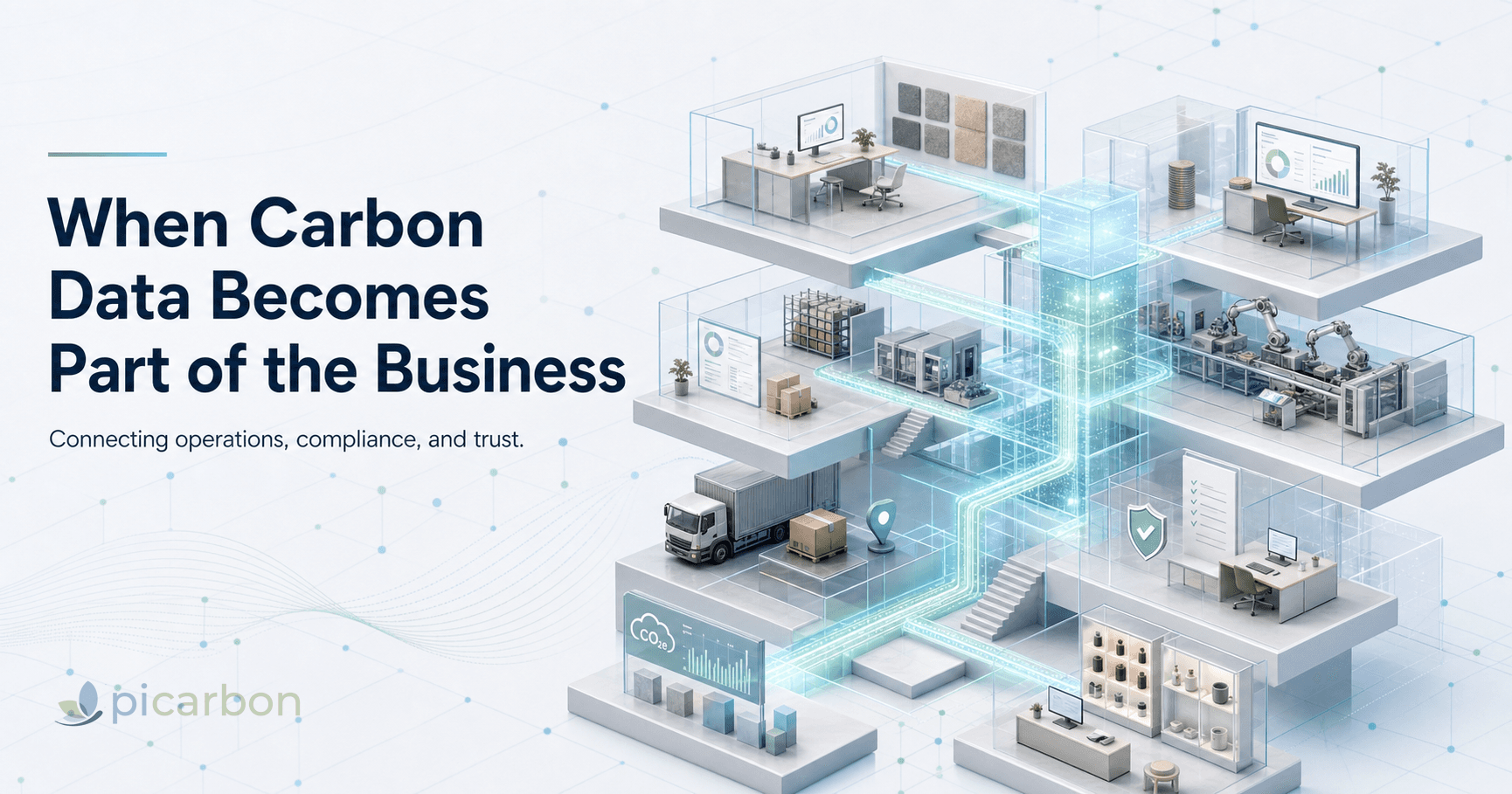
Every business is a network of connected decisions.
Information is what holds that network together.
A purchasing decision changes material cost. Material choice influences production. Production determines energy use. Logistics affects delivery time. Quality shapes customer experience.
No decision exists entirely on its own.
Carbon follows the same logic.
A product’s carbon footprint is shaped by the materials it contains, the energy used to manufacture it, the distance it travels, the suppliers involved, and what happens after it is used.
Carbon information does not belong to one department. It moves across procurement, production, logistics, finance, product development, and sustainability.
Until recently, many businesses could afford to leave these connections largely invisible.
That is beginning to change.
Regulations are demanding more credible emissions information. Customers and business partners are asking more questions about how products are made. Companies are also discovering that carbon measurement can reveal inefficient processes, unnecessary transportation, material waste, and other hidden operational costs.
Carbon is therefore becoming more than a sustainability metric.
It is becoming part of the infrastructure connecting how a business operates, how it meets its obligations, and how it is understood by the market.
Compliance Is Changing Carbon Data
Carbon reporting was once largely periodic.
A company collected information, prepared a report, submitted it, and returned to the exercise the following year.
Product-level requirements are changing that rhythm.
The European Union’s Carbon Border Adjustment Mechanism offers one of the clearest examples.
CBAM entered its definitive regime on 1 January 2026. It initially applies to selected goods in cement, iron and steel, aluminium, fertilisers, electricity, and hydrogen. EU importers exceeding the applicable 50-tonne threshold must meet authorisation and reporting obligations and purchase certificates corresponding to the embedded emissions of covered imports.
The regulation does not ask only for a final number.
Where actual emissions are used, the required records can include the installation where goods were produced, details of its operator, verification reports, and the specific embedded emissions of the goods.
For producers outside Europe, the legal obligation may sit with the importer. But the information often begins much further back in the supply chain.
A buyer cannot report what its supplier cannot measure.
This is how compliance moves between businesses—not only through regulations, but through requests for information.
Sources: European Commission: CBAM Definitive Regime and Regulation (EU) 2023/956.
The Number Is Only the Surface
A product carbon footprint may appear as one number, usually expressed in kilograms or tonnes of carbon dioxide equivalent.
But the number is only the visible surface.
Beneath it are many pieces of information.
Where the materials came from.
How much electricity was consumed.
Which production processes were included.
How far the product travelled.
Which emission factors were applied.
Which supplier provided the information.
What assumptions were made when primary data was unavailable.
The credibility of the result depends on the ability to follow the number back through these decisions.
ISO 14067 sets out principles, requirements, and guidelines for quantifying and reporting the carbon footprint of a product. Its approach is consistent with established life-cycle assessment standards, recognising that a product must be understood as a system rather than as an isolated object.
The current 2018 edition was reviewed and confirmed in 2024, while a revision is now under development.
Product carbon accounting is becoming an established—and evolving—business discipline.
Source: ISO 14067:2018—Carbon Footprint of Products.
A carbon number becomes credible when a business can explain where it came from.
Without that chain of evidence, the number may exist. But it becomes difficult to verify, update, compare, or trust.
No Company Holds the Whole Story
A product may carry one brand name.
Its carbon story belongs to many organisations.
Raw materials may come from several suppliers. Components may be manufactured in different factories. Logistics providers move goods between locations. Energy is consumed at multiple stages. Packaging, product use, and end-of-life treatment add further layers of information.
No company holds the whole picture alone.
The GHG Protocol’s guidance for purchased goods and services recognises supplier-specific, cradle-to-gate emission factors as an important source of information. It also recommends requesting details about data quality and giving preference to verified supplier data where possible.
Source: GHG Protocol: Category 1—Purchased Goods and Services.
This makes carbon management more than a calculation problem.
It is also a collaboration problem.
Suppliers need to understand what information is required. Buyers need a consistent way to request and evaluate it. Both sides need confidence that commercially sensitive information can be exchanged responsibly.
The quality of a product’s carbon footprint will increasingly depend on the quality of these connections.
From Spreadsheets to Readiness
Spreadsheets are flexible, familiar, and often the easiest place to begin.
The limitation appears when the information changes.
A material is replaced.
A supplier updates its production method.
An electricity emission factor is revised.
A customer requests a different reporting boundary.
If the calculation must be reconstructed manually each time, the organisation is not only repeating work. It also risks using outdated information, losing supporting evidence, or applying inconsistent assumptions.
The problem is not the spreadsheet itself.
The problem is continuity.
Carbon information needs ownership, version control, supporting documents, clear calculation rules, and a reliable process for updates.
A product carbon footprint should not be a static answer.
It should be the current output of a living information system.
This is the difference between carbon reporting and carbon readiness.
Reporting responds to a request.
Readiness means the business already knows where the information is, who owns it, how reliable it is, and how it can be used.
Carbon Data and Brand Trust
Customers may never examine every line of a carbon calculation.
But they increasingly notice whether a company can explain its impact with clarity and evidence.
For many years, sustainability communication existed at some distance from operations. A company made a commitment. A campaign communicated it. A report described the progress.
Carbon data brings the promise and the operation closer together.
If a brand says that a product has a lower impact, the claim must eventually connect to materials, energy, production, logistics, and information from suppliers.
This does not make branding less important.
It makes branding more accountable.
A credible carbon footprint can strengthen the story behind a product. An unsupported environmental claim can weaken it.
In a market crowded with environmental language, evidence creates distinction. Businesses able to explain what they measured, how they measured it, and what they improved can communicate with greater confidence.
Trust has always been one of the most valuable assets a brand can build.
Carbon data gives that trust something tangible to stand on.
A New Layer of Business Infrastructure
Compliance may be the reason many companies begin measuring carbon.
Efficiency may reveal its operational value.
Customer perception may give it commercial meaning.
But infrastructure is what connects all three.
Once carbon information becomes part of everyday operations, it can show where energy is being consumed, where materials create disproportionate impact, where transport can be improved, and where suppliers differ.
It can also show whether the story told by a brand is supported by the reality of how its products are made.
Financial infrastructure helps a company understand value.
Operational infrastructure helps it understand performance.
Carbon infrastructure helps it understand impact—and the commercial risks and opportunities connected to that impact.
The businesses best prepared for carbon compliance may not be those producing the most reports.
They may be those building the connections that make reporting routine, improvement visible, and communication credible.
Because when carbon becomes part of the information holding a business together, it is no longer an exercise performed after the work is done.
It becomes part of how the business works.

